HelloFresh
Sep 2022-Apr 2023

Background
HelloFresh is Canada's largest meal kit, having an overwhelming dominance in market share. It's growth was especially fueled during the COVID-19 lockdown where a large portion of Canadian consumers shifted towards the meal kit culture.
Not only was it a safer alternative during the lockdown, but it also provided customers with a remarkable variety of meals, while still letting them reap the joy of cooking, as well as customize their meal according to their preferences (i.e. keto, vegan, pescatarian, etc.)
The dilemma they now faced was a stagnating, and possibly declining market as the world exited from lockdown
The numbers were proof — conversion rates were nowhere near the peaks they reached during lockdown
It also did not help that more players were entering the market and now nibbling at our market share dominance.
My Solution
Project Framework: Built a PDCA (Plan-Do-Check-Act) project management style framework to continuously improve Direct Mail campaigns month after month
A/B Testing: Standardized 3 categories of A/B tests and conducted 40+ tests to optimize conversion rates among other metrics
Audit-Style Analytics: Analyzed historical data, conducting segment analyses, weekly drop-off (churn) analysis, and conversion trajectory to build a forecasting model


Campaign Management Framework
HelloFresh could previously afford inefficiencies in its marketing strategy, due to an unsaturated market and a COVID-19 lockdown-driven need for meal kit services. However, the new post-COVID era required us to maximally optimize its campaigns, perhaps even try blue sky ideas that had never been attempted before.
Unfortunately 2 months into my contract, my direct manager left her role for another opportunity. I was tasked with now independently managing the Direct Mail channel, the company's largest channel in terms of driving conversions.
I outlined an end-to-end campaign management process, which would not only ensure that the campaigns were delivered all across Canada, but would also A/B test campaigns and incrementally optimize conversion rates using a PDCA framework (Plan-Do-Check-Act)
Plan
Decide the A/B tests, mailing volumes, locations, metrics & objectives for each month's campaigns
Do
Prep & send assets to printers, setup landing pages & tracking URLs, filter postal codes to target
Check
Build campaign dashboards, confirm hypotheses, and draft campaign reports
Act
Take the learnings from previous campaigns and implement them into the next month's A/B tests
A/B tests conducted
40+
Postal codes targeted
800k




Plan-Do-Check-Act
A/B Testing
Geo-Targeting
Campaign Management

A/B Testing
There were 3 kinds of A/B tests I performed:
Creative
Comparing messaging, visual imagery or creative elements
Audience
Comparing different segments or provinces
Discount
Comparing various discount structures
Here are just some of my successful A/B tests:
$130 off vs 7 free meals
Regular discount vs free tote bag
2 month cadence vs 4 month cadence
11 free meals (across 5 boxes) vs 11 free meals (across 6 boxes)
Sustainability messaging in BC vs sustainability messaging in ON
Post card codes vs voucher card scratch codes
Simple discount code (DEC2022) vs custom discount (3XV 8B5)
Conversions achieved
34k+
Mail sent
15mil+


Conversion Rate Optimization
Lead Generation
Post-Campaign Analysis
Documentation
Direct Mail
Audit-Style Analytics
Some other analyses I was able to perform are listed below. These were critical and complementary in helping further optimize campaigns and productivity:
Segment Analysis
I analyzed all 68 segments the existing customer base was categorized into by our partner (Environics) and mapped the CR (conversion rate) and CLV (customer lifetime value) for each, ranking them in descending order. I then assigned a segment to each postal code (a list of 800k postal codes was provided to us by Canada Post). This analysis helped us understand which segments are not profitable or difficult to convert, and hence focus on targeting the ones that are.

Forecasting Model
Used the past 3 years of conversion data to map the conversion trajectory based on 'days since campaign launch'. This allowed us to forecast how many conversions we would have with 97% accuracy over the next 30-60-90 days within only 7 days of launching a campaign.

Box Drop Off Rate
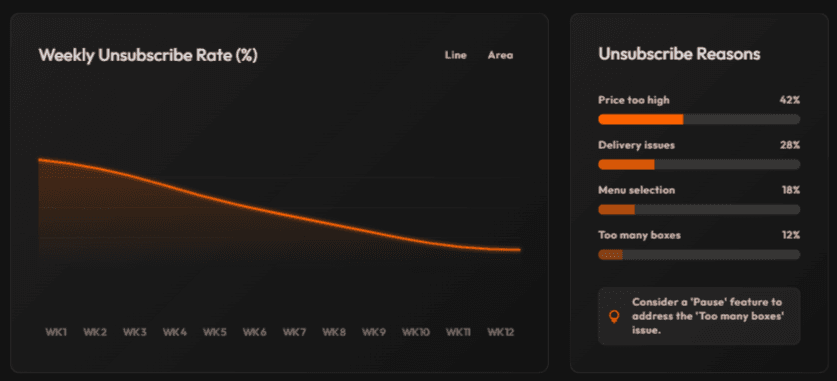
Since HelloFresh discount deals were only redeemable if the customer had ordered a certain number of boxes over a certain number of weeks, we needed to pin point after how many boxes/weeks were customers cancelling their subscription. I extracted the necessary data using SQL to examine after how many weeks a customer became inactive. This allowed us to plan for new A/B tests with adjusted discounted structures.
Workflow Automation
With my manager leaving after 2 months of my contract beginning, I was faced with a heavy workload. I setup automated workflows to drastically cut work time. This meant automating the mundane aspects of campaign management, such as updating dashboards, pulling in new data, running SQL scripts, updating landing pages, and more. Ultimately, this aided in saving 5+ hours per week from my schedule.

Forecast accuracy
97%
Dashboards built
3
Team hours saved
20+




Conversions Forecasting
Segmentation
Dashboarding
Automation
Outcome
Conversion Rates: At the beginning of my contract, the average campaign conversion rate hovered around 0.18%. At the end of my contract, the conversion rate now hovered at 0.25%.
Market Dominance: Apart from that, with a total of 15 million+ mail sent under my supervision, HelloFresh's undisputed market share dominance was maintained.
Audit-Style Analytics: Analyzed historical data, conducting segment analyses, weekly drop-off (churn) analysis, and conversion trajectory to build a forecasting model
Conversion rate uplift
39%
Learnings
Marketers possess the ability to get extremely granular in terms of how they use their data to optimize conversion rates. The aspects of a campaign that can be A/B tested are nearly limitless.
In this respect, data can also be used to minimize any uncertainties, be that via creating forecasting models or pin pointing causes for churn, as long as a marketer is eager to dig deeper beyond the surface.